Dottie's story
I learned the game the way the lucky ones do: underfoot. My mother's group met Thursdays — card tables in the living room, the good candy dish out, four women who had seen each other through everything the world could think to throw. I was supposed to be doing homework. Instead I sat beneath the table matching the clack of the tiles to the rhythm of their talk, and by twelve I could read a discard pile better than I could read a room. When they finally dealt me in, I understood I hadn't just joined a game. I'd been handed a seat in something older and warmer than I had words for.
The name came later. I always did favor the dots — clean, honest, easy to count on, which is everything I ask of a tile or a friend — and the girls started calling me Dottie for it. It stuck harder than my given name ever did.
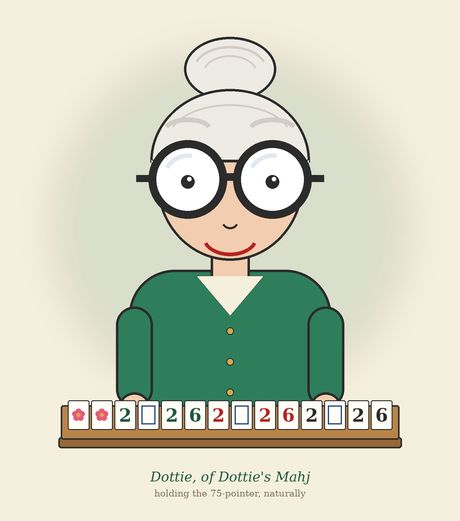
The decades since have been one long apprenticeship to this game. I've played the year's card every year it's been printed since I was old enough to buy my own — and you should see my bookshelf. I've sat tournament tables and kitchen tables, played through new babies and lost husbands, taught in living rooms, rec rooms, synagogue basements, and once, memorably, a hospital waiting room where nobody wanted to check the clock. I've made the 75-point hand more times than is polite to mention, which is why the artist drew me holding it. And I have learned the two great truths of American mahjong: the card always makes sense eventually, and the friendships always arrive before the skill does.
What I believe about teaching
I believe the card is a map, not a test. Fifty-five lines sounds like an examination; eight familiar shapes wearing different numbers sounds like a neighborhood, and I teach it as one — we stroll it together, street by street, until you know which houses welcome your tiles.
I believe drills beat lectures ten to one, that a memory phrase said aloud is worth a page of explanation, and that nobody ever learned this game while feeling foolish. So at my table, questions are never silly, first mahjongs are applauded loudly enough to alarm the neighbors, and the only house rule that cannot be repealed is kindness.
I believe in your own card in your own hands — we never photocopy, dear; the League that makes the card earns its fifteen dollars every year — and I believe the fastest way to learn is beside other learners. Which is why everything I make points the same direction: toward a table with people around it.
How I teach
Gently, in order, and with snacks. We start with your thirteen tiles and the five headline counts, not with rules — you'll be reading a hand the first afternoon. Then the shapes, one family at a time, each with its phrase, each phrase sticking a dozen lines to your memory at once. Then the craft: the Charleston as a conversation, the discard pile as a newspaper, defense as good manners with teeth. By the time we're through, you don't remember the card. You recognize it — the way you recognize a friend's kitchen.
And when you call your first mahjong — and you will — I want to hear about it. That inbox is the happiest place I own. — D.